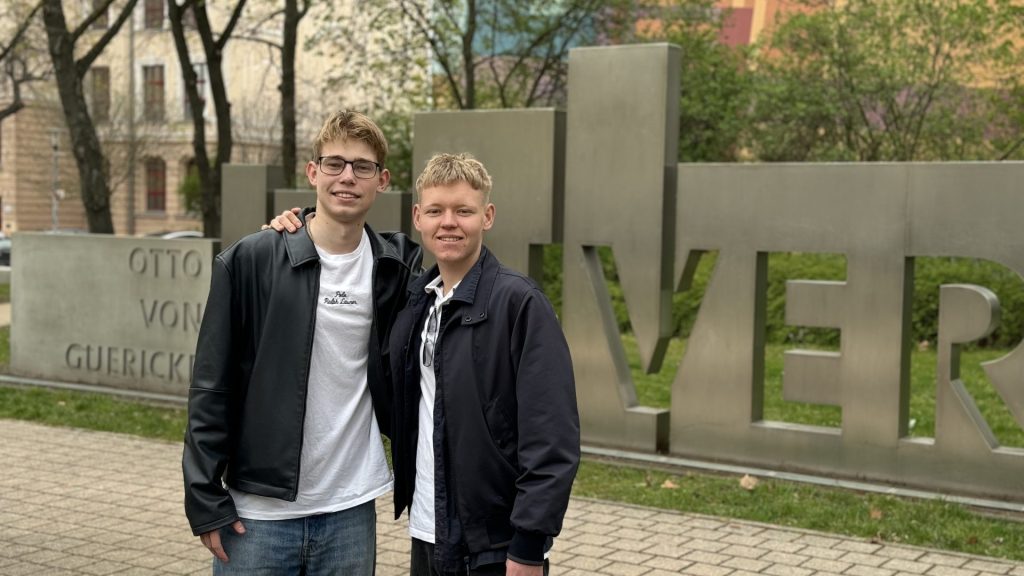
A unique joint project between NTU «Kharkiv Polytechnic Institute» ( NTU «KhPI») and Otto von Guericke University Magdeburg (Germany)—the DSG2 dual-degree program for Ukrainian refugees in Germany—has been in operation since 2022. It offers the opportunity to combine engineering training at NTU «KhPI» with studies in Germany. This format allows students to experience different educational approaches, better understand the European academic system, and prepare for an international career. Currently, 113 students of NTU «KhPI» are already studying at both universities, and another 141 are preparing for admission. Program participants Anton Kresan and Volodymyr Drovnikov share their journey—from language challenges to their first professional steps.
Anton Kresan (IKM-723в) and Volodymyr Drovnikov (E-123a), students at the National Technical University «Kharkiv Polytechnic Institute,» are enrolled in the DSG2 dual-degree program at Otto von Guericke University in Magdeburg, Germany. Here, they are not only receiving a European education but also gradually building their own professional paths, combining Ukrainian engineering training with the practices of a German technical school. The first year was a period of intense immersion in a new academic reality for them—with a fast pace, different approaches to learning, and a constant sense of challenge. «This stage was a mix of emotions: difficult, unfamiliar, but at the same time very interesting,» recalls Anton. Volodymyr adds: «My impressions are very positive. I’m really glad I enrolled in this program and got into my major.» One of the most memorable moments for him was the project to build a LEGO robot—from the initial idea to the final presentation: «It was a kind of mini-model of my future professional work.» It is precisely these kinds of tasks that help students experience how theory translates into practice and forms engineering thinking.
Language became the most serious barrier: even at the B1–B2 level, lectures are difficult to follow at first due to the terminology and the pace of instruction. «It’s difficult at first with both B1 and B2. It all depends on how quickly you adapt and whether you keep learning the language,» notes Anton. Eventually, adds Volodymyr, confidence sets in: lectures become clearer, and everyday communication becomes more natural. The most important thing is not to be afraid to speak: «I haven’t encountered any negative reactions because of my language—on the contrary, people are supportive.»
The structure of the learning process became a revelation in itself: more freedom means more responsibility. There is no constant supervision here, but there is a clear understanding that the outcome depends on the student themselves. «It’s not about coercion, but about the fact that you yourself determine how far you want to go,» explains Anton. This approach teaches students to manage their time, work systematically throughout the semester, and independently organize not only their studies but also their daily lives. At the same time, this experience isn’t limited to the classroom: students at Kharkiv Polytechnic are already working within the university environment. Volodymyr Drovnikov teaches math in a preparatory course for German freshmen and joins to the M2 module: «I prepare materials, conduct classes, and record students’ results.»
Anton Kresan works as a research assistant at the Institute of Engineering and Automation at Otto von Guericke University. In a lab that collaborates with ODVA, he tests technical solutions. For him, this is an opportunity to simultaneously pursue his degree in Electrical Engineering and Information Technology at NTU «Kharkiv Polytechnic Institute» and in Magdeburg. Combining study and work, they say, is entirely feasible provided one is self-organized. «I have 35 hours a month, and I choose when to work,» says Anton. Volodymyr emphasizes that such a workload does not interfere but, on the contrary, complements his studies with practical experience. The main motivation for both remains a sense of personal growth: «I’m motivated by the fact that I’m doing something truly useful and growing as a person,» says Volodymyr, while Anton adds: «When you see that you didn’t understand something yesterday, but today you can already explain it to someone else—that’s really energizing.»
Speaking from their own experience, students at NTU «Kharkiv Polytechnic Institute» advise future program participants not to be afraid of a new environment, to communicate more, and not to view the language barrier as insurmountable. «Don’t shy away from meeting new people—the language barrier is temporary,» Anton emphasizes. At the same time, it’s important to maintain a balance between studies and life—spending time with friends, relaxing, and pursuing hobbies, adds Volodymyr, who describes his experience in Magdeburg as «an interesting, useful, and exciting journey». Summing it up, Anton puts it succinctly: «It’s tough, but definitely worth it!» It is precisely in these words, as emphasized by the DSG2 program coordinator and head of the German Education Center at NTU «KhPI,» Professor Denys Meshkov, that its essence is most accurately conveyed: it is a demanding path that requires independence, discipline, and perseverance, but at the same time opens up new academic, professional, and personal opportunities.
«We are truly proud of our students: they represent NTU «KhPI» with dignity in Germany and prove that Ukrainian engineering education has strong potential and a bright future,» notes Denys Meshkov.
Note:
The DSG2 dual-degree program is a comprehensive educational initiative designed to support Ukrainian high school graduates who are currently in Germany or other EU countries due to the war. Given the specificities of the European education system, graduates of Ukrainian high schools are typically unable to enroll directly in German universities. Under the DSG2: neo program, they first enroll at NTU «KhPI» and begin their studies remotely. After completing their first year, students are admitted to Otto von Guericke University in Magdeburg, where they continue their studies as full-fledged students of the German university. The program involves moving to Magdeburg and living in a student dormitory. The DSG2: neo project is being implemented by NTU «KhPI» in collaboration with Otto von Guericke University Magdeburg and has been active since June 2022. It is aimed at Ukrainian applicants currently in Germany and covers priority fields of study such as electrical engineering, mechanical engineering, and chemical technology. The updated agreement on the implementation of the DSG2neo dual-degree program between NTU «KhPI» and Otto von Guericke University was signed in Magdeburg (Germany) on April 13, 2026.
Otto von Guericke University Magdeburg (OVGU) is one of the country’s leading technical universities, located in the city of Magdeburg. Founded in 1993 through the merger of several educational and research institutions, it is named after the German scientist and inventor Otto von Guericke. The university has a distinct focus on engineering, technology, and the natural sciences. Its main fields of study include electrical engineering, mechanical engineering, computer science, energy, chemistry, and medical engineering. Significant attention is paid to research activities and collaboration with industry. OVGU actively participates in international educational programs and academic mobility projects, maintaining partnerships with universities in various countries, including Ukraine. The partnership between Otto von Guericke University and the National Technical University «KhPI» has a long history.